Case Study
Collapsing a 13-Minute Workflow for a Music Booking Team
Company
Yonas Media
Role
Solo Designer, Developer & Project Lead
Type
Enterprise
Year
2026
The Brief
I wasn’t handed this project — I went looking for it. The goal was to find a real company with a real problem and solve it end-to-end: define what to build, design it, and build it.
Yonas Media manages roughly 15 active touring artists. Their booking operation ran across 15 individual Google Sheets, a CRM with 9,000+ venue records disconnected from the booking calendar, and verbal handoffs between three core team members.
After an introductory meeting with Ben (business owner), I constructed a brief with a clear goal: establish a consolidated live view of every artist, their availability, booking status, and venue data — built for how the team worked.
The Hidden Cost
Before writing a line of code, we timed the work. Benchmarking with Ben revealed that evaluating a single booking inquiry — checking artist availability, cross-referencing routing, looking up a venue — took 13 minutes. He handles 10 to 15 of them a day. Downstream, Kylie was spending 1 minute 15 seconds re-entering confirmed booking data into the contract system — the same data Ben had already entered, copied by hand. Two people. Two workflows. We now had the benchmarks that would define success.
Current-state journey map — Ben. Booking inquiry response flow, documented before any design work began. Five stages, peak frustration at stage two.
Built Around How They Think
The decisions that shaped the tool came directly from working sessions with Ben and Kylie. Listening for how they actually thought about their work — not what they asked for — is what drove the directions sketched out here: a date-first entry model, and a venue search that considered both a venue-name approach and a broader search by city or state.
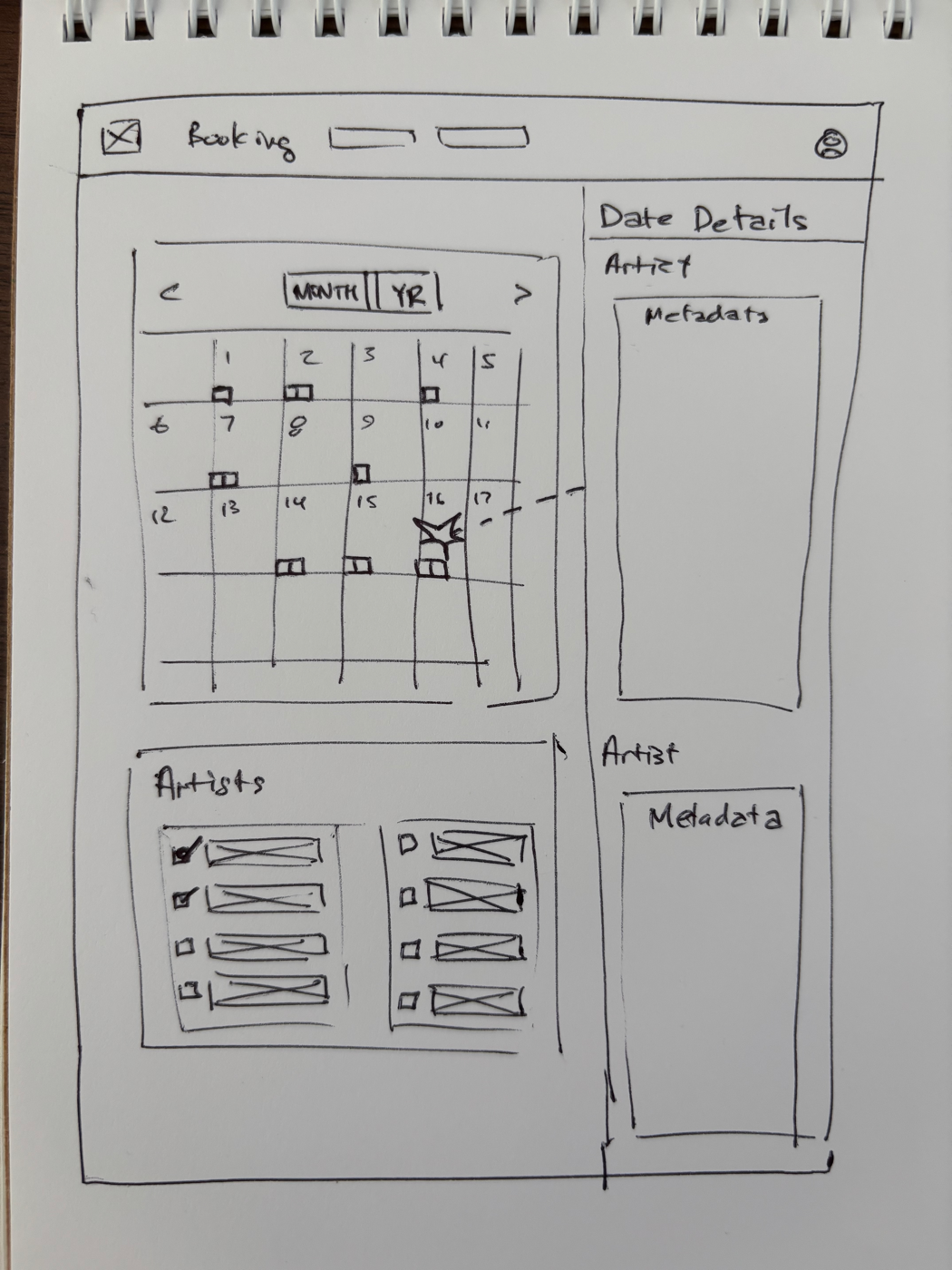
Calendar-first layout. Ben didn’t think in lists — he thought in calendars. This sketch explored mapping artist availability to a month view, closer to how he already reasoned about routing.
Finding the Visual Language
Before writing a line of CSS, I wanted to understand how the team thought about the tool aesthetically — not just functionally. A short moodboarding exercise with the team surfaced what tools they used daily, what products they admired, and how they wanted the tool to feel. The direction that emerged was confident and utilitarian — something that felt built for professionals, not assembled from a template.
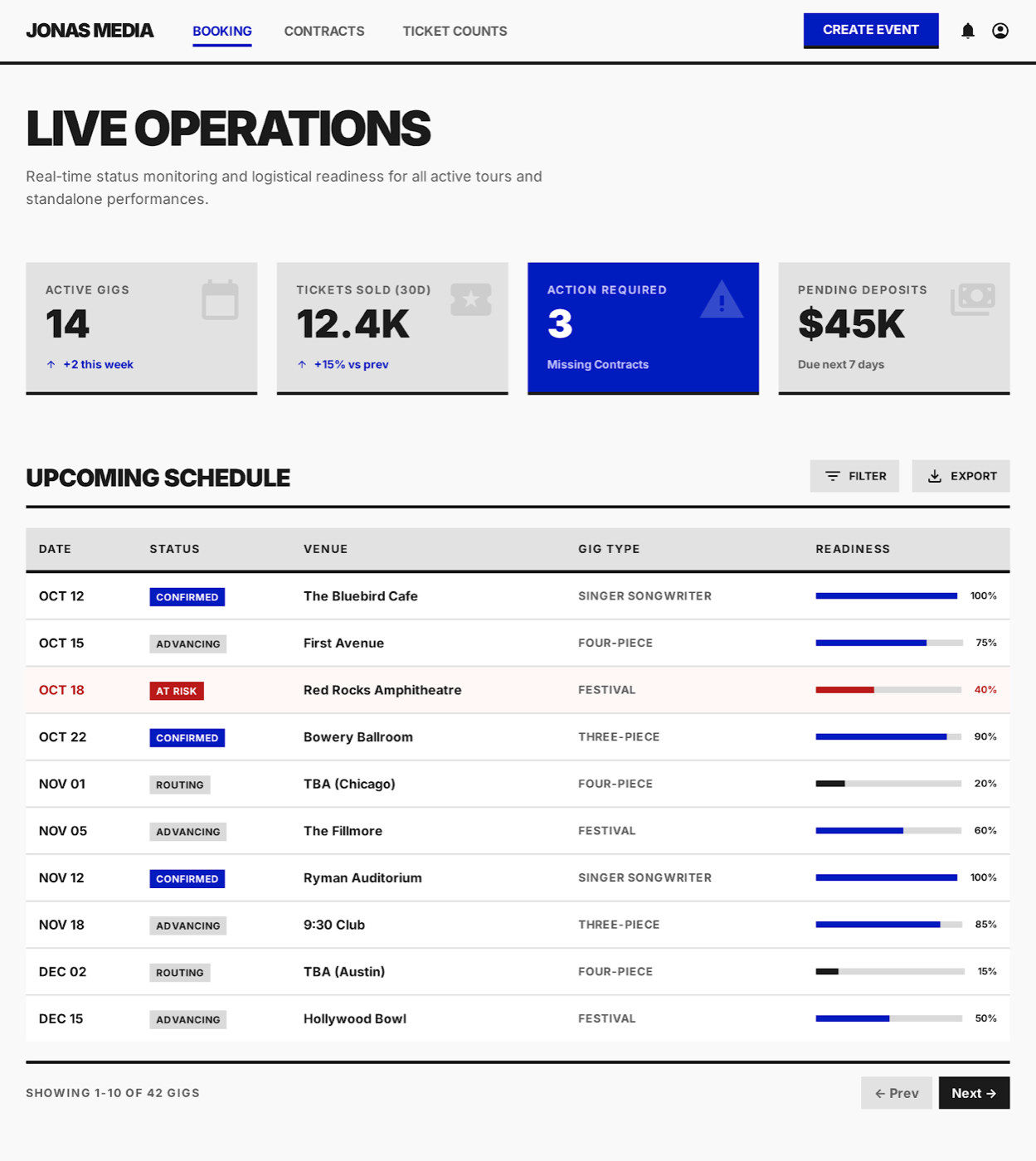
Neo-Swiss. Inspired by Linear and Vercel. Precise and structured, but the high contrast felt cold and fatiguing for all-day use.
Built to Be Used
There was no handoff on this project because there was no one to hand off to. As the designer and the developer, every decision from research to deployment was the same person’s call — which compressed the feedback loop from days to minutes, and meant the tool could be in beta with real users while it was still being built. The constraint was the same one Ben faces every day: booking season doesn’t wait. The tool had to be reliable before it had to be perfect.
One tension worth naming: the original Google Sheets had eight to ten columns, and the team was attached to them. Reducing that to the most commonly used fields meant pushing back on familiar patterns — but the horizontal scrolling and cognitive load those extra columns created was working against the tool’s core job. Simplicity won. The columns that stayed are the ones that get used every day.
| Date (2026) | Status | City | State | Country | Venue | Gig Type | Artist Config | Readiness |
|---|---|---|---|---|---|---|---|---|
| Mon Feb 23 | Confirmed | San Francisco | CA | US | The Fillmore | Four-piece | Headliner | Ready |
| Wed Feb 25 | Confirmed | Memphis | TN | US | Orpheum Theatre | Three-piece | Headliner | 4 left |
| Sun Mar 1 | Hold | Atlanta | GA | US | Fox Theatre | Four-piece | Co-headline | 6 left |
| Thu Mar 5 | Offer | Chicago | IL | US | Silverline Arena | Three-piece | Support | 9 left |
| Sat Mar 8 | Need to Fill | — | — | — | Open date | — | — | 11 left |
| Fri Mar 13 | Serious | Detroit | MI | US | Warehouse 7 | Singer-SW | Headliner | 7 left |
| Wed Mar 18 | Confirmed | Los Angeles | CA | US | The Blue Note | Four-piece | Headliner | Ready |
| Sun Mar 22 | Interest | Milwaukee | WI | US | Turner Hall | Four-piece | Support | 10 left |
Yonas Media / A Booking Story
Live prototype. Pan the calendar, toggle artists, click any date to explore.
A New Baseline
Two weeks after launch, we ran the same timed sessions with Ben and Kylie — same tasks, same conditions. The goal was simple: find out if the benchmarks we’d set before building anything had moved.
One thing that shifted post-launch: the team discovered they needed date ranges, not single dates. It was an eleventh-hour adjustment — though not a surprising one. Routing logic rarely lives on a single day. The benchmarks moved sharply, and the expectation is they’ll move further as the tool matures.
The Result
Reduced booking inquiry time from 13 min to 1 min 10 sec
Reduced contract entry time from 1 min 15 sec to ~5 sec
90% daily active usage across a 15-person team
This is a live product, in active daily use by a team of ~20. The work isn’t finished — it’s in its second cycle, with a third already visible on the horizon. Want to see where this goes next?